Indian Passport

Indian passports are issued to citizens of India for the purpose of international travel. They act as proof of Indian nationality. The Consular Passport & Visa (CPV) Division of the Ministry of External Affairs, functioning as the central passport organisation, is responsible for issuance of Indian passports to all eligible Indian citizens. Passports are issued from 37 locations across the country and 162 Indian missions abroad.
Types of passports
Regular passport (Deep Blue/Black cover) – Issued for ordinary travel, such as vacations and business trips (36 or 60 pages)
Diplomatic passport (Maroon cover) – Issued to Indian diplomats, top ranking government officials and diplomatic couriers.
Official passport (White cover) – Issued to individuals representing the Indian government on official business
Physical appearance
Indian passports have a deep blue/black cover, with the Emblem of India emblazoned in the center of the front cover. The words Hindi: ‘पासपोर्ट’ and English: ‘Passport’ inscribed above the Emblem and Hindi: ‘भारत गणराज्य’ and English: ‘Republic of India’ inscribed below the emblem.
Passport holder identity
Indian passports have identity information printed on both front and back cover ends. Both of these pages are laminated to prevent modification.
The opening cover end contains the following information:
Photo of Passport Holder
Signature of the passport holder
Type (P)- Stands for “Personal”
Country code (IND)
Passport number
Surname
Given names
Nationality (Indian)
Sex
Date of Birth
Place of birth
Place of issue
Date of issue
Date of expiry
The information page ends with the Machine Readable Passport Zone.
The closing end contains the following information:
Name of father/legal guardian
Name of mother
Name of spouse
Address
Old passport no. with date and place of issue
File no.
Languages
The textual portions of Indian passport are printed in both Hindi and English.

Comets

Comets are in orbit around the Sun as are our planets.
Comets are composed of ices, dust and rocky debris carried from the early formation of the solar system about 4.5 billion years ago.
Comets are remnants from the cold, outer regions of the solar system. They are generally thought to come from two areas – the Oort Cloud and the Kuiper Belt. Both of these are areas where materials left over from the formation of our solar system have condensed into icy objects. Both regions extend beyond the orbits of Neptune and Pluto but are still part of our solar system and much closer to us than the closest star.
Comet orbits are elliptical. It brings them close to the sun and takes them far away.
Short period comets orbit the Sun every 20 years or less. Long period comets orbit the Sun every 200 years or longer. Those comets with orbits in between are called Halley-type comets.
Comets have three parts: the nucleus, the coma and the tails. The nucleus is the solid center component made of ice, gas and rocky debris. The coma is the gas and dust atmosphere around the nucleus, which results when heat from the Sun warms the surface of the nucleus so that gas and dust spew forth in all directions and are driven from the comet’s surface. The tails are formed when energy from the Sun turns the coma so that it flows around the nucleus and forms a fanned out tail behind it extending millions of miles through space.
We see a comet’s coma and tail because sunlight reflects off the dust (in the coma and dust tail) and because the energy from the Sun excites some molecules so that they glow and form a bluish tail called an ion tail and a yellow one made of neutral sodium atoms.
Scientists have seen comets range in size from less than 1 km diameter to as much as 300 km, although the 300km (called Chiron) does not travel into the inner solar system.
We know a comet could impact Earth and that it is important to understand the nature of comets so we can design better methods to protect ourselves from them should one be on a collision path with Earth.
A comet nucleus has a dark, sometimes mottled surface but we don’t know if it has an outer crust or if it is layered inside. We don’t really know what comets are like beneath their surface and that’s why we need a mission like Deep Impact.

Mayans

The earliest Mayans were probably nomadic hunters and gatherers
By 250 a.d. they had settled into communities
The people traded food, pottery and jewelry
The Mayans people were small the men were about five feet tall and women were around four feet tall
The Mayans used things from the forest to make rope and baskets
The main foods were beans, corn and squash
Mayans huts were made out of logs mud and palm leaves
The Mayans kept dogs as pets raised turkeys for food
The Mayans used a number system based on 20 they were the first to use zero
The Mayans believed in human sacrifice
The Mayans tried to be kind to every one
Around 800 AD, the Mayans abandoned there cites no one knows why this happened
Today many Mayans live in villages in central America
in 1992 Rigoberto menchu tum received the noble peace prize for bringing the Mayan people and the Guatemala government together

The Cat

1. Tylenol and chocolate are both poisonous to cats.
2. The ancestor of all domestic cats is the African Wild Cat which still exists today.
3. In ancient Egypt, killing a cat was a crime punishable by death.
4. In ancient Egypt, mummies were made of cats, and embalmed mice were placed with them in their tombs. In one ancient city, over 300,000 cat mummies were found.
5. In the Middle Ages, during the Festival of Saint John, cats were burned alive in town squares.
6. The first cat show was in 1871 at the Crystal Palace in London.
7. Today there are about 100 distinct breeds of the domestic cat.
8. Genetic mutation created the domestic cat which is tame from birth.
9. Like birds, cats have a homing ability that uses its biological clock, the angle of the sun, and the Earth’s magnetic field. A cat taken far from its home can return to it. But if a cat’s owners move far from its home, the cat can’t find them.
10. Hunting is not instinctive for cats. Kittens born to non-hunting mothers may never learn to hunt.
11. Cats bury their feces to cover their trails from predators.
12. Mother cats teach their kittens to use the litter box.
13. Among other tasks, cats can be taught to use a toilet, come, sit, beg, eat with their paws, heel, jump through a hoop, play a piano, play dead, roll over, open a door, hide food in boxes, shake, and fetch.
14. Cats sleep 16 to 18 hours per day. When cats are asleep, they are still alert to incoming stimuli. If you poke the tail of a sleeping cat, it will respond accordingly.
15. Cats can’t taste sweets.

Tea


1. The origins of tea:
Legend has it that tea originated well over 5000 years ago in ancient China. The innovative and science-curious emporer Shen Nung insisted that for hygeine purposes, all water in the palace must be boiled. When he was out visiting his kingdom one day, him and his men stopped to boil water to drink and it was said that leaves from a nearby bush fell into the water. Apparently the brew that resulted was so refreshing, the emporer ordered samples of the bush to be brought back to the palace for analysis. Afterwards, word got out and this new phenomenon became fashionable.

2. From the Camellia bush:

Both black and green teas are made from the Camellia sinensis bush and have similar quantities of antioxidants and caffeine.

3. Antioxidant:
Tea contains catechins, a type of antioxidant which has been found to reduce people’s risk of heart disease, stroke and diabetes. Catechins can also be found in cocoa and dark chocolate.
4. Vitamins and minerals:
When combined with milk, tea can offer an array of vitamins and minerals including calcium, vitamin B6, Riboflavin B2, Thiamin B1, manganese for bone growth and repair, and potassium, important for neuron and brain function.

5. Puffy eyes and sunburn:
Teabags can be used to reduce the swelling of puffy eyes. Lie on your back and place a moist teabag over both eyes and leave on for around 20 minutes, this leaves your eyes feeling fresher, brighter, and looking revitalised. Also, a wet teabag can be used to soothe burns and sunburn. By either placing the teabag straight onto the burn or pouring tea into cool bathwater, it has been known to take away the burn’s sting and help the skin heal faster.

6. Tea reduces risk of heart attacks:
Research conducted in the Netherlands suggests that tea can help people avoid heart attacks, especially women. Johanna M Geleijnse, PhD from the Erasmus Medical Center in Rotterdam led a study which followed 4807 Dutch adults over the age of 55 who had no heart problems in their previous medical history.

7. Odour absorbant:
It has been found that tea can work as an odour absorbant, removing bad smells especially from your skin. Pouring a cup over your hands is said to work wonders for all kinds of bad odours!

8. Warts and all:
Tea can be used to treat warts as the tannin present in tea is acidic. This element makes tea as effective at removing warts as creams and ointments. Leaving a moist teabag on the wart for 15 minutes, 3 times per day, will cause the wart to shrink and disappear.

9. Caffeine:
The caffeine content of tea is approximately half of the amount that you’d find in a cup of brewed coffee. Whereas coffee provides around 100mg per 190ml cup, tea provides just 50mg, leaving you without the caffeine “drop” so familiar to coffee drinkers.

10. Oral Health:
A report issued by the UK Tea Council in 2006 stated that the fluoride content of tea makes it a potent defender of oral health. Fluoride binds to the tooth enamel, slowing down the tooth decay process and preventing cavities. Also, the instance of tannins in tea inhibits the growth of certain plaque-forming bacteria.

Pen

20120129-135620.jpg
Lewis Waterman patented the first practical fountain pen in 1884. Writing instruments designed to carry their own supply of ink had existed in principle for over one hundred years before Waterman’s patent.
For example, the oldest known fountain pen that has survived today was designed by a Frenchmen named M. Bion and dated 1702. Peregrin Williamson, a Baltimore shoemaker, received the first American patent for a pen in 1809.
John Scheffer received a British patent in 1819 for his half quill, half metal pen that he attempted to mass manufacture. John Jacob Parker patented the first self-filling fountain pen in 1831. However, early fountain pen models were plagued by ink spills and other failures that left them impractical and hard to sell.
The fountain pen’s design came after a thousand years of using quill-pens. Early inventors observed the apparent natural ink reserve found in the hollow channel of a bird’s feather and tried to produce a similar effect, with a man-made pen that would hold more ink and not require constant dipping into the ink well.
Filling a long thin reservoir made of hard rubber with ink and sticking a metal ‘nib’ at the bottom was not enough to produce a smooth writing instrument.
Lewis Waterman, an insurance salesman, was inspired to improve the early fountain pen designs after destroying a valuable sales contract with leaky-pen ink. Lewis Waterman’s idea was to add an air hole in the nib and three grooves inside the feed mechanism.
A mechanism is composed of three main parts. The nib, which has the contact with the paper. The feed or black part under the nib controls the ink flow from the reservoir to the nib. The round barrel that holds the nib and feed on the writing end protects the ink reservoir internally.
All pens contain an internal reservoir for ink. The different ways that reservoirs filled proved to be one of the most competitive areas in the pen industry. The earliest 19th century pens used an eyedropper; by 1915, most pens had switched to having a self-filling soft and flexible rubber sac as an ink reservoir.
To refill these pens, the reservoirs were squeezed flat by an internal plate, then the pen’s nib was inserted into a bottle of ink and the pressure on the internal plate was released so that the ink sac would fill up drawing in a fresh supply of ink.

RAT

20120129-135738.jpg
Rats have poor vision. To compensate for this, a red or pink eyed rat will often weave its head side to side to add “motion” to see better. They also don’t see in color.
Rats normally prefer to have cage mates. It is possible to group female or male rats together, though care should be taken when introducing a new rat.
While it’s great to have both female and male rats, be wary of letting them play together; rats can complete the courting ritual and the whole romantic relationship in about two seconds.
Generally speaking, male rats make better “lap” pets, preferring to sit and have their ears scratched by an attentive human friend. Female rats are very curious, and love to explore and play games. Both genders make great companions.
Rats can eat chocolate.
Rats can also eat smaller pets. Rats are omnivores, and have enough predatory instinct left in them to consider birds, fish and even some smaller rodents as “snacks.”
Rats don’t have canine teeth.
Rats don’t have thumbs.
The oils in cedar and pine are toxic to rats, and should not be used in their bedding materials.
A rat’s temperature is regulated though its tail (assuming it has one). A really hot rat will lay on its back so that it can “sweat” through the soles of its feet.
Rats can’t vomit. A rat can, however, gag on something if it eats too quickly. The plus side of this is that rats can usually eat and drink before surgery.
It is unlikely you will ever catch rabies from a rat.
Soda does not make rats explode.
Rats bathe themselves, usually six times a day or more. A rat’s saliva has some pink pigmentation, which can cause a light-colored rat to look discolored. A warm washcloth with baby shampoo is great for those trouble spots.
PEW stands for “Pink Eyed White” the fancy rat terminology for “albino” or any all-white rat with pink eyes. Conversely, BEW stands for “Black Eyed White” (which is not an albino).
Rats have bellybuttons.
Rats don’t have gallbladders.
Rats don’t have tonsils.
A rat’s fur smells like grape soda.

Venus

20120129-135816.jpg
Venus is known as Earths’ twin sister because of its similar size and proximity to each other.
Its atmosphere is made up mostly of carbon dioxide.
Venus rotates so slowly that it orbits the sun faster than it can make one whole rotation on its axis. In other words, Venus has a longer day than year.
It takes 243 days for Venus to make a rotation.
And it takes 224 days for Venus to orbit around the sun.
Venus is the most widely explored planet aside from our own Earth. Numerous space probes have been sent to Venus to gather data and some have landed on the surface.
It is believed that Venus used to have bodies of water similar to Earth, but dried up over a period of 300 million years when the sun began admitting more solar energy after the sun’s infancy stage.
The clouds of Venus is filled with sulfuric acid.
Venus has mountains that are higher than Earth. Maat Mons is more than 5 miles high.
Venus is the brightest planet viewed from Earth.
The planet rotates from East to West. The only other planet that does this is Uranus.

Strange Facts

The largest eggs in the world are laid by a shark.

A crocodile’s tongue is attached to the roof of its mouth.

Giraffes are unable to cough.

Sharks are immune to cancer.

Despite the hump, a camel’s spine is straight.

Cheetah’s can accelerate from 0 to 70 km/h in 3 seconds.

A giraffe’s neck contains the same number of vertebrae as a human.

The heart of giraffe is two feet long, and can weigh as much as twenty four pounds.

On average, Elephants sleep for about 2 hours per day.

Lobsters have blue blood.

Shark’s teeth are literally as hard as steel.

A mosquito has 47 teeth.

Oxygen, carbon, hydrogen and nitrogen make up 90% of the human body.

Ants do not sleep.

Rats multiply so quickly that in 18 months, two rats could have over 1 million descendents.

Hummingbirds can’t walk.

Batu Caves Murugan Temple

Name: Batumalai Sri Subramaniar Swamy Devasthanam
Country: Malaysia
State: Selangor
District: Gombak
Locale: 13 km north of Kuala Lumpur
Primary deity: Murugan
Architectural styles: Dravidian Architecture
Date built: 1891
Creator: K. Thamboosamy Pillai
Batu Caves, is a limestone hill, which has a series of caves and cave temples, located in Gombak district, 13 kilometres north of Kuala Lumpur, Malaysia. It takes its name from the Sungai Batu or Batu River, which flows past the hill. Batu Caves is also the name of the nearby village.
History
The limestone forming Batu Caves is said to be around 400 million years old. Some of the cave entrances were used as shelters by the indigenous Temuan people.
As early as 1860, Chinese settlers began excavating guano for fertilising their vegetable patches. However, they became famous only after the limestone hills were recorded by colonial authorities including Daly and Syers as well as American Naturalist, William Hornaday in 1878.
Batu Caves was promoted as a place of worship by K. Thamboosamy Pillai, an Indian trader. He was inspired by the ‘vel’-shaped entrance of the main cave and was inspired to dedicate a temple to Lord Muruga within the caves.
In 1890, Pillai, who also founded the Sri Mahamariamman Temple, Kuala Lumpur, installed the murti (consecrated statue) of Sri Subramania Swamy in what is today known as the Temple Cave. Since 1892, the Thaipusam festival in the Tamil month of Thai has been celebrated there.

Remote Control

General History
The first machines to be operated by remote control were used mainly for military purposes. Radio-controlled motorboats, developed by the German navy, were used to ram enemy ships in WWI. Radio controlled bombs and other remote control weapons were used in WWII.
Once the wars were over, United States scientists experimented to find nonmilitary uses for the remote control. In the late 1940′s automatic garage door openers were invented, and in the 1950′s the first TV remote controls were used.
History of the TV remote control
Zenith began playing around with the idea of a TV remote control in the early 1950′s. They developed one in 1952 called “Lazy Bones,” which was a long cable that was attached to the TV set. Pushing buttons on the remote activated a motor that would rotate the tuner in the set. This type of remote wasn’t popular for long considering that, at the time, there were very few channels to choose from.
In 1955, the Flash-o-Matic was invented. A flashlight was shined toward light sensitive cells in each of the four corners of the TV. Each corner had a different function. They turned the TV on and off, changed the channel, and controlled the volume. However, people often forgot which corner of the TV operated which control. Also, if the set was in sunlight, the sun’s rays would affect the operations of the TV.
In 1957 a group of engineers developed the Zenith “Space Command,” a wireless remote control using ultrasonic waves. The problem with the ultrasonic control was that clinking metal, such as dog tags, could affect the TV set.
High frequencies sometimes also made dogs bark. The ultrasonic remote was used for two decades until engineers discovered a better way to operate TV’s, the infrared remote control.
On the infrared control, each button has it’s own command, and is sent to the TV set in a series of signals. There is a digital code for each button, and in the TV there is a tiny sensor called a photodetector that identifies the infrared beam, and translates the code into a command.
Manufacturers used to only make remote controls that operated one TV set. However, they’ve recently begun making universal remote controls that can operate any TV set.
Experts predict that someday remote controls will control almost every device in the home.

THE NEXT BEST THIN IS COMING IS GESTURE CONTROL.

North Pole

North Pole definition

North Pole is situated in the norther hemisphere where the Earth’s axis of rotation meets the Earth’s surface. There is a big difference between Geographic North Pole and Magnetic North Pole.
The Earth’s North Magnetic Pole is the point on the Earth’s surface at which the Earth’s magnetic field points vertically downwards. Magnetic north pole location moves constantly with time. The location of magnetic north pole was defined at 82.7°N 114.4°W in 2005.
James Clark Ross was first who reached the North Magnetic Pole in June 1, 1831. The fact is that the Magnetic North Pole is physically a magnetic field south pole.
North Pole location
The North Pole is located in the middle of the Arctic Ocean which constantly covered with shifting sea ice. The North Pole latitude is 90° North.
At the North Pole all lines of longitude converge there, so North Pole longitude can be defined as any degree value. Greenland is the closest land to geographic north pole (700 km / 440 mi away).
North Pole climate
North Pole weather is much warmer than in South Pole. It is situated in Polar climate zone. The average north pole temperature during winter time is -34°C (-30°F) and average North Pole summer temperature is 0°C (32°F).
The temperature of North Pole changes during last 20 years. Many scientists consider it as a result of global warming. The thickness of ice at the north pole is 3-4 meters.
History of North Pole exploration
The exploration of North Pole has a long history. It is known North Pole fact that the first man who cross Arctic Circle was Greek geographer and explorer Pytheas of Massilia at about 320 BC. So he is considered a first Polar explorer.
The first North Pole map was made by D. Gerasimov, Russian sailor, in the first half of XVI century. But nevertheless the main steps of North Pole discovery were made much later – in the beginning of the last century.
Explorers and enthusiasts tried to achieve North Pole using all possible ways – dog sleds and planes, dirigibles and nuclear icebreakers, skis and parachutes.
It is considered that the first person in the North Pole was Robert Peary. He claimed that he reached the North Pole on April 6, 1909 together with Matthew Henson and four Inuit men. However, it is still controversial north pole fact.
People, who accompanied Peary during the journey, weren’t trained in navigation and couldn’t independently confirm his own navigational results. The other American explorer Frederick Albert Cook stated to have reached the North Pole on April 21, 1908, but he didn’t provide the convincing proof.

Crows

As members of the corvid family, crows are considered to be among the most adaptable and intelligent birds in the world.
Crows are generally black, with black beaks and legs, but they can also be black with white, gray, or brown coloring.
Crows have a varied and evolved language. They can mimic the sounds made by other animals, and they learn to associate noises with events, especially with the distribution of food.
Well-adapted to diverse habitats, crows are found across North America. They thrive in cities and suburban areas where they live in close association with humans.
Crows roost at night in large flocks of up to several thousand during the winter. During the day, smaller groups may fly up to fifty miles in pursuit of food.
Crows are omnivorous. They eat whatever is available to them in their habitat including insects, small amphibians and snakes, earthworms, eggs and nestling birds, and clams, mussels, and other salt-water invertebrates. They also scavenge carrion, garbage, and eat wild and cultivated fruit and vegetables.
With a preference for coniferous trees, crows build their nests in woods or isolated trees at least sixty feet above ground. Nests are solidly built of branches and twigs, and are lined with bark, plant fibers, mosses, twine, and other found materials.
Crows nests are bulky structures built in trees or bushes. They are made of twigs, lined with bark, grasses, and rootlets.
Paired male and female crows share in the incubation of four to six eggs which hatch in eighteen days. Young first fly when they are about one month old. Frequently, at least one young bird will remain with its parents through the next nesting season to assist in the care of new nestlings by bringing them food and guarding the nest.
The female crow lays 4-7 eggs in the nest, and the male helps incubate them. These eggs are greenish or bluish, and blotched with brown. Once hatched, the young remain in the nest 6 – 8 weeks, and in their early life they eat almost half of their weight per day in food, which the parents bring to them.
They are migratory, and will assemble in large flocks in the fall, to travel south.
They eat a number of pests which are harmful to those same crops, including cutworms, wireworms, grasshoppers and even noxious weeds.

Strange Facts – 10

The largest flying animal was the pterosaur which lived 70 million years ago. This reptile had a wing span of 36-39 feet (11-11.9 meters) and weighed 190-250 pounds (86-113.5 kilograms).
The greatest tide change on earth occurs in the Bay of Fundy. The difference between low tide and high tide can be as great as 54 ft. 6 in. (16.6 meters).
The highest temperature produced in a laboratory was 920,000,000 F (511,000,000 C) at the Tokamak Fusion Test Reactor in Princeton, NJ, USA.
The heaviest human brain ever recorded weighed 5 lb. 1.1 oz. (2.3 kg.).
The deepest part of the ocean is 35,813 feet (10,916 meters) deep and occurs in the Mariana Trench in the Pacific Ocean. At that depth the pressure is 18,000 pounds (9172 kilograms) per square inch.
The largest cave in the world (the Sarawak Chamber in Malaysia) is 2,300 feet (701 meters) long, 980 feet (299 meters) wide, and more than 230 feet (70 meters) high.
The hottest planet in the solar system is Venus, with an estimated surface temperature of 864 F (462 C).
The ears of a cricket are located on the front legs, just below the knee.
The first electronic digital computer (called ENIAC – the Electronic Numerical Integrator and Calculator) was developed in 1946 and contained over 18,000 vacuum tubes.
Sound travels about 4 times faster in water than in air.
Boron nitride (BN) is the second hardest substance known to man.
The seeds of an Indian Lotus tree remain viable for 300 to 400 years.
Velcro was invented by a Swiss guy who was inspired by the way burrs attached to clothing.
The microwave was invented after a researcher walked by a radar tube and a chocolate bar melted in his pocket.

Kulfi

Kulfi or Qulfi is a popular frozen dairy dessert from the Indian Subcontinent. It is often described as “traditional Indian Subcontinent ice-cream”.It is popular throughout countries such as India, Pakistan, Bangladesh, Nepal, Burma (Myanmar), and even the Middle East. Kulfi is also widely available in Indian restaurants in Europe, East Asia and North America.
Kulfi has similarities to ice cream in appearance and taste, but is denser and creamier. It comes in various flavours, including cream (malai), raspberry, rose, mango, cardamom, saffron, and pistachio, the more traditional flavours, as well as newer variations like apple, orange, strawberry, peanut, and avocado. Unlike Western ice creams, kulfi is not whipped, resulting in a solid, dense frozen dessert similar to traditional custard based ice-cream.
Thus, it is sometimes considered a distinct category of frozen dairy-based dessert. Due to its density, kulfi takes a longer time to melt than Western ice-cream.
History
Just like any other culture exposed to snow and ice, some people living in the Indian Subcontinent, especially those living high in the Himalayas, would have stumbled upon the technique of freezing various sweetened liquids, thus turning them into frozen desserts. These privileges were limited to the aristocracy until modern day refrigeration technology reached the Subcontinent.
Preparation
Kulfi was traditionally prepared by evaporating sweetened and flavored milk by slow cooking, with almost continuous stirring to keep milk from sticking to the bottom of the vessel where it might burn, until its volume was reduced by a half, thus thickening it, increasing its fat, protein and lactose density.
It has a distinctive taste due to caramelization of lactose and sugar during the lengthy cooking process. The semi-condensed mix is then frozen in tight sealed molds that are then submerged in ice mixed with salt to speed up the freezing process.
The ice/salt mix, along with its submerged kulfi molds, is placed in earthen pots or matkas that provide insulation from the external heat and slow down the melting of ice. Kulfi prepared in this manner is hence called ‘Matka Kulfi’. Kulfi, thus prepared by slow freezing, also renders a unique smooth mouth feel that is devoid of water crystallization.
Traditionally in India, kulfi is sold by vendors called kulfiwallahs who keep the kulfi frozen by placing the moulds inside a large earthenware pot called a “matka”, filled with ice and salt. It is served on a leaf or frozen onto a stick.
It can be garnished with pistachios, cardamom and similar. Often it is served as Falooda Kulfi which is kulfi with rice noodles, rose syrup and other ingredients. Popular flavors include pistachio, mango, vanilla, and rose.

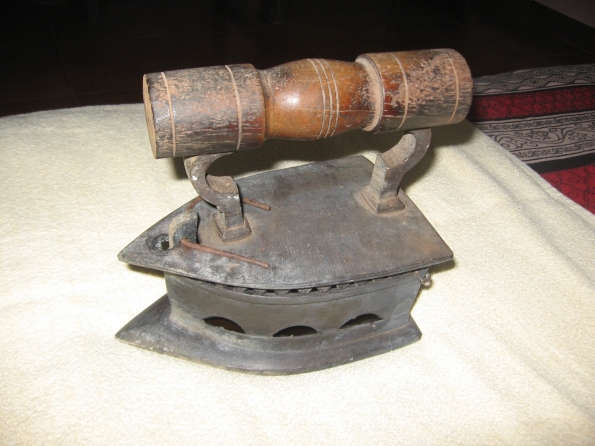
Clothes Iron

A clothes iron, also referred to as simply an iron, is a small appliance used in ironing to remove wrinkles from fabric. Ironing works by loosening the ties between the long chains of molecules that exist in polymer fiber materials.
With the heat and the weight of the ironing plate, the fibers are stretched and the fabric maintains its new shape when cool.
Some materials such as cotton require the use of water to loosen the intermolecular bonds. Many materials developed in the twentieth century are advertised as needing little or no ironing.
The electric iron was invented in 1882 by Henry W. Seeley, a New York inventor. Seeley patented his “electric flatiron” on June 6, 1882 (patent no. 259,054).
History
Metal pans filled with hot water were used for smoothing fabrics in China in the 1st century BC. From the 17th century, sadirons or sad irons began to be used. They were thick slabs of cast iron, delta-shaped and with a handle, heated in a fire. These were also called flat irons.
A later design consisted of an iron box which could be filled with hot coals, which had to be periodically aerated by attaching a bellows. In Kerala in India, burning coconut shells were used instead of charcoal, as they have a similar heating capacity.
This method is still in use as a backup device since power outages are frequent. Other box irons had heated metal inserts instead of hot coals.
Another solution was to employ a cluster of solid irons that were heated from the single source: as the iron currently in use cools down, it could be quickly replaced by another one that is hot.
In the late nineteenth and early twentieth centuries, there were many irons in use which were heated by a fuel such as kerosene, ethanol, whale oil, natural gas, carbide gas as with carbide lamps, or even gasoline.
Some houses were equipped with a system of pipes for distributing natural gas or carbide gas to different rooms in order to operate appliances such as irons, in addition to lights. Despite the risk of fire, liquid-fuel irons were sold in U.S. rural areas up through World War II.
In the industrialized world, these designs have been superseded by the electric iron, which uses resistive heating from an electric current. The hot plate, called the sole plate, is made of aluminium or stainless steel.
The heating element is controlled by a thermostat which switches the current on and off to maintain the selected temperature. The invention of the resistively heated electric iron is credited to Henry W. Seeley of New York in 1882.
In the same year an iron heated by a carbon arc was introduced in France, but was too dangerous to be successful. The early electric irons had no easy way to control their temperature, and the first thermostatically controlled electric iron appeared in the 1920s. Later, steam was used to iron clothing. Credit for the invention of the steam iron goes to Thomas Sears.

Dreams

 
1. You Forget 90% of Your Dreams
Within 5 minutes of waking half of your dream is forgotten. Within 10, 90% is gone.
2. Blind People also Dream
People who became blind after birth can see images in their dreams. People who are born blind do not see any images, but have dreams equally vivid involving their other senses of sound, smell, touch and emotion.
3. Everybody Dreams
Every human being dreams. If you think you are not dreaming – you just forget your dreams.
4. In Our Dreams We Only See Faces That We already Know
Our mind is not inventing faces – in our dreams we see real faces of real people that we have seen during our life but may not know or remember.
5. Not Everybody Dreams in Color
A full 12% of sighted people dream exclusively in black and white. The remaining number dream in full color.
6. Dreams are Symbolic
If you dream about some particular subject it is not often that the dream is about that. Dreams speak in a deeply symbolic language. Whatever symbol your dream picks on it is most unlikely to be a symbol for itself.
7. Emotions
The most common emotion experienced in dreams is anxiety. Negative emotions are more common than positive ones.
8. You can have four to seven dreams in one night.
On average you can dream anywhere from one or two hours every night.
9. Animals Dream Too
Studies have been done on many different animals, and they all show the same brain waves during dreaming sleep as humans. Watch a dog sleeping sometime.
10. Body Paralysis
Rapid eye movement (REM) sleep is a normal stage of sleep characterized by rapid movements of the eyes. REM sleep in adult humans typically occupies 20-25% of total sleep, about 90-120 minutes of a night’s sleep.
11. Dream Incorporation
Our mind interprets the external stimuli that our senses are bombarded with when we are asleep and make them a part of our dreams. This means that sometimes in our dreams we hear a sound from reality and incorporate it in a way.
12. Men and Women Dream Differently
Men tend to dream more about other men. Around 70% of the characters in a man’s dream are other men. On the other hand, a woman’s dream contains almost an equal number of men and women.
13. Precognitive Dreams
Results of several surveys across large population sets indicate that between 18% and 38% of people have experienced at least one precognitive dream and 70% have experienced déjà vu.
14. If you are snoring, then you cannot be dreaming.
This fact is repeated all over the Internet, but I’m a bit suspicious whether it’s really true as I haven’t found any scientific evidence to support it.

Kutraalam

Kutraalam is a panchayat town situated at a mean elevation of 160 m, on the Western Ghats in Tirunelveli District of Tamil Nadu, India. Many seasonal and a few perennial rivers such as the Chittar River, the Manimuthar River, the Pachaiyar River and the Tambaraparani River originate in this region. The numerous waterfalls and cascades along with the ubiquitous health resorts in the area have earned it the title the Spa of South India.

Location
Nestled in the Western Ghats, Kutraalam has exquisite surroundings. The charming hillocks which dominate the scenery disappear into the blue mist of Agasthiarmalai, the mountain bearing the name of a sage who made immense contributions to Tamil literature and is believed to have lived in the area.
The closest towns to Kutraalam are Sengottai and Tenkasi at 5 km and Panpoli at 9 km away. The closest airport is Tuticorin Airport approximately 86 km away and the nearest railway station is Tenkasi, 5 km away.
Falls in Kutraalam
Kutraalam has nine waterfalls.
Peraruvi (main falls) the biggest, is about 60m high. The water, interrupted by the Pongumakadal, a 19m deep crater, comes down with greatly reduced impact, making a bath there safe.
In Chitraruvi (small falls), the flow is thin. Here nature has provided separate places for men and women to bathe. Chitraruvi leads to other waterfalls such as Shenbagadevi and Thenaruvi and the herbal farm.
At Shenbagadevi falls, the water flows through shenbaga (Michaelia champak) trees. There is also a temple there, dedicated to Shenbagadevi Amman.
About 3km from this is Thenaruvi (honey falls), 40m high and cascading between two large stones. In places where there is no water, one sees big honeycombs.
Aintharuvi (five falls) is one where one thoroughly enjoys being in a crowd of bathers. Five separate cascades of water form this waterfalls.
From the orchard above flows Pazhathotta Aruvi, the ‘VIP falls’.
The Pazhaya Courtalla Aruvi (Old Kutraalam falls) used to fall into a valley from between two rocks. The valley was closed and the rocks were broken to change the course of water and make bathing easier. It was reopened later.
The artificial Puli Aruvi (Tiger Falls) has a moderate flow of water which collects in a lake and is diverted for irrigation.
The three major waterfalls reachable by road are the Main Falls, Five Falls, and Old Kutraalam Falls. Other waterfalls like Shenbaga Devi Falls and Honey Falls are reachable only by trekking on the mountain. The smaller falls called the Tiger Falls, called by that name as it was known to have been frequented by tigers looking for water. There is another small falls inside the Government Horticulture Park above Five Falls, but it is off limits to the public. Other attractions include the boat houses near Five Falls and Old Kutraalam Falls, snake park, a public aquarium, small children’s parks and play areas.

Burj Khalifa

Basic facts
1. Burj Khalifa is located in Dubai, United Arab Emirates (UAE).
2. It’s 828 metres tall (2,717 feet).
3. The exact height was not revealed until final stages of the construction.
4. It was officially opened on Jan 4, 2010.
5. It was previously known as Burj Dubai.
6. Burj means Tower in Arabic language.
7. It’s renamed after Sheikh Khalifa bin Zayed Al Nahyan, the President of UAE and ruler of Abu Dhabi.
World records
8. Tallest building – previously Taiwan’s Taipei 101 (509m).
9. Tallest free-standing structure – previously Canada’s CN Tower (555m).
10. Tallest man-made structure – previously USA’s KVLY-TV Mast (629m).
11. Tallest man-made structure ever – previously Poland’s Warsaw Radio Mast (647m).
12. Building with most floors (160) – previously USA’s World Trade Center (110).
13. Highest elevator installation.
14. Highest outdoor observation deck (~440m)
15. Highest mosque at 158th floor.
16. Fastest elevators at speed of 64km/h, or 18m/s.
17. It would take just a minute to reach from ground level to top floor.

Tortoise

Turtles have been on the earth for more than 200 million years. They evolved before mammals, birds, crocodiles, snakes, and even lizards.
The earliest turtles had teeth and could not retract their heads, but other than this, modern turtles are very similar to their original ancestors.
Turtles live on every continent except Antarctica.
Turtles will live in almost any climate warm enough to allow them to complete their breeding cycle.
While most turtles do not tolerate the cold well, the Blanding’s turtle has been observed swimming under the ice in the Great Lakes region.
Turtles range in size from the 4-inch Bog Turtle to the 1500-pound Leathery Turtle.
North America contains a large variety of turtle species, but Europe contains only two species of turtle and three species of tortoise.
The shell of a turtle is made up of 60 different bones all connected together.
Most land tortoises have high, domed carapaces that offer protection from the snapping jaws of terrestrial predators.
Most turtle species have five toes on each limb with a few exceptions including the American Box Turtle of the Carolina species that only has four toes and, in some cases, only three.
Turtles have good eyesight and an excellent sense of smell. Hearing and sense of touch are both good and even the shell contains nerve endings.
Some aquatic turtles can absorb oxygen through the skin on their neck and cloacal areas allowing them to remain submerged underwater for extended periods of time and enabling them to hibernate underwater.
Turtles are one of the oldest and most primitive groups of reptiles and have outlived many other species. One can only wonder if their unique shell is responsible for their longevity.